
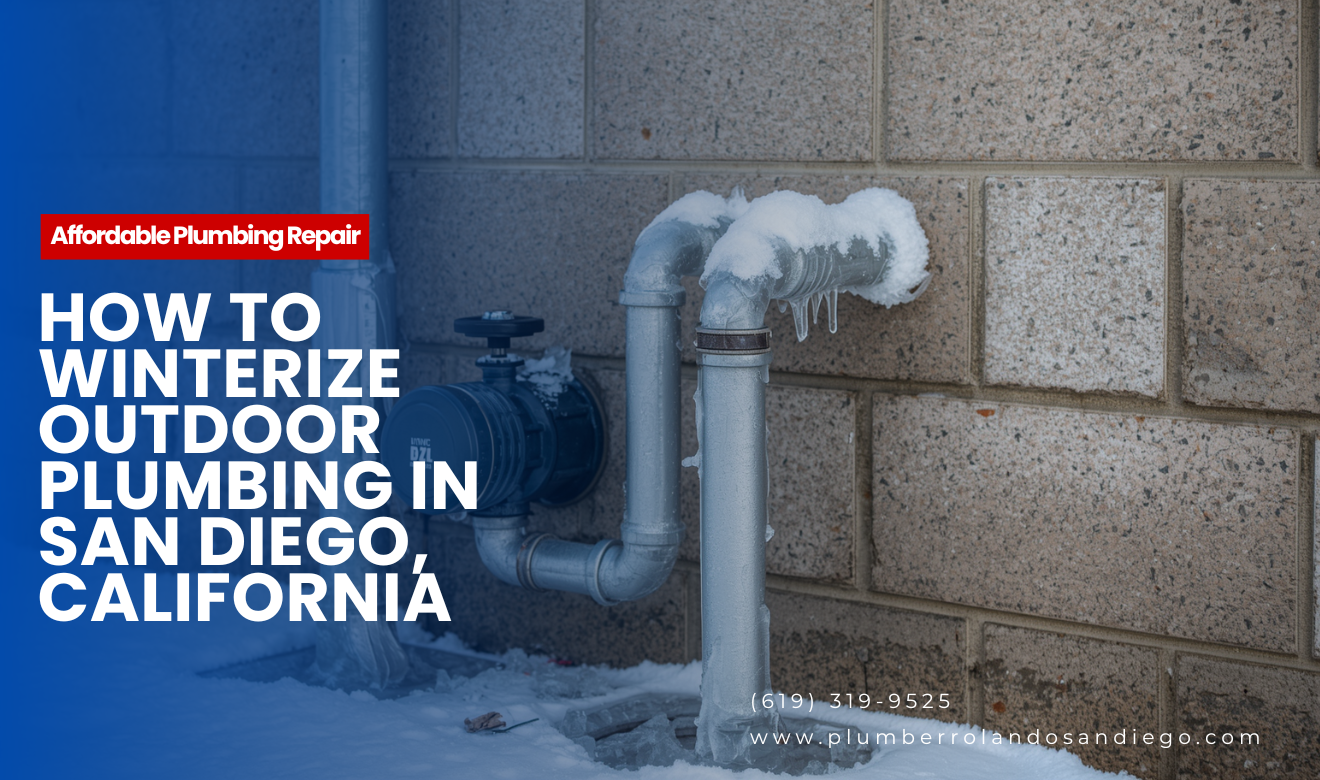
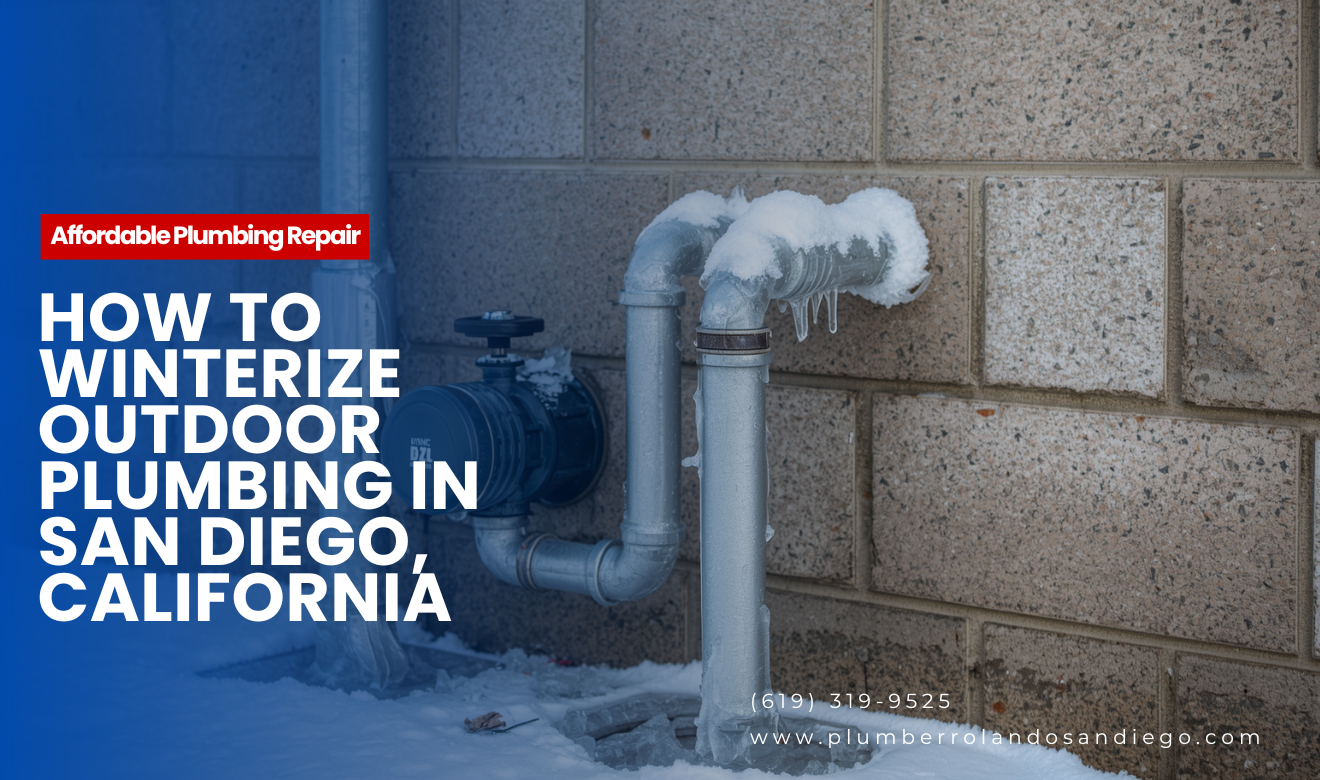
Executive Summary
Winterizing outdoor plumbing in SoCal San Diego is a quick, low-cost way to prevent freeze-related damage during occasional cold snaps, even in a generally mild climate. The key is to drain trapped water, isolate vulnerable lines, and insulate exposed components before temperatures drop into the mid-30s°F.
Key Takeaways
- Mild climate, real freeze risk: San Diego’s main threat is one or two cold nights where trapped water freezes and cracks hose bibs, backflow preventers, and short exterior pipe runs.
- Disconnecting hoses is the fastest prevention: Removing and draining garden hoses prevents water from being trapped in the faucet body—one of the most common causes of cracked spigots.
- Backflow assemblies are high-priority: Above-ground backflow preventers are especially vulnerable because they hold water and are exposed to wind, making draining test cocks and insulating critical.
- Shut off and drain outdoor fixtures from inside: For patio sinks, outdoor kitchens, and showers, closing indoor supply valves and opening exterior fixtures to drain reduces pressure and freeze expansion risk.
- Inspect after the thaw to catch hidden damage: Many freeze cracks leak only after temperatures rise, so next-day checks of hose bibs, backflow unions/test cocks, irrigation boxes, and the water meter can prevent bigger losses.
To winterize outdoor plumbing SoCal San Diego homeowners usually just need to shut off outdoor water, drain exposed lines, and protect any parts that can freeze on colder nights. San Diego winters are mild, but a surprise 35–40°F overnight can still crack a hose bib, backflow preventer, or a short run of pipe on an exterior wall.
For example, disconnect and drain garden hoses, then leave the spigot open for a minute to let water drip out. If you have an irrigation system, turn off the controller, close the irrigation shutoff valve, and drain the backflow device if it’s above ground. For outdoor kitchens or patio sinks, shut off the supply valves inside, open the faucet outside, and let the line empty before a cold snap.
These small steps take a few minutes, cost very little, and can prevent a sudden leak when temperatures bounce back the next day.
Why winterize outdoor plumbing SoCal San Diego homeowners should still take seriously
Even in a mild coastal climate, winterize outdoor plumbing SoCal San Diego routines can prevent some of the most expensive “small” repairs: a split hose bib, a cracked backflow body, or a pinhole leak that shows up the next morning when things thaw.
Here’s the simple physics: water expands by about 9% when it freezes. That expansion can burst fittings, valves, and pipe walls—especially in short, exposed runs on exterior walls, in unheated garages, or where wind hits equipment directly. (Source: U.S. Geological Survey, “Water expands when it freezes.”)
San Diego’s risk is less about weeks of freezing and more about one or two cold nights where:
- a hose is still attached and traps water in the bib,
- a backflow preventer sits above ground,
- an outdoor shower/kitchen line runs through an exterior wall, or
- sprinkler components hold water in a shaded area.
If you want a fast win, focus on the parts that hold water and are exposed to air.
How to winterize outdoor plumbing SoCal San Diego step-by-step (quick checklist)
If you’re trying to winterize outdoor plumbing SoCal San Diego style, this is the most practical order of operations—designed for a cold snap, not a Midwest freeze.
1) Disconnect and drain every hose
- Remove hoses from hose bibs and hose reels.
- Drain hoses fully (walk them out so low spots empty).
- Store hoses out of the weather if possible.
Why it matters: A connected hose can trap water in the faucet body, which is one of the most common ways exterior faucets crack.
2) Drain the hose bib (spigot) and protect it
- Turn the spigot on for 10–30 seconds after disconnecting the hose.
- If you have an interior shutoff for that line, close it and then open the outdoor spigot to drain down.
- Add an inexpensive insulated faucet cover before the coldest night.
3) Winterize irrigation basics (no compressor required for most San Diego homes)
- Turn off the irrigation controller (or set to “Rain/Off”).
- Close the irrigation shutoff valve.
- Open the downstream drain/bleeder if your system has one.
- Drain any above-ground backflow device (see next step).
4) Drain and protect above-ground backflow preventers
Backflow assemblies are often the most freeze-sensitive outdoor component because they’re elevated, metallic, and full of trapped water.
- Shut off the upstream and downstream isolation valves.
- Open test cocks to relieve pressure and allow drainage (have a towel/bucket).
- Insulate the assembly (wrap designed for plumbing—avoid sealing moisture inside).
If your backflow is due for service, this is a good time to schedule professional Backflow Devices inspection/repair so it’s ready before the next cold night.
5) Outdoor kitchens, patio sinks, and exterior showers
- Locate the hot/cold shutoff valves indoors (often under a sink, in a garage, or utility area).
- Turn both valves off.
- Open the outdoor fixture to drain the line.
- Leave the faucet in the “open” position overnight during the cold snap.
6) Don’t forget “hidden outdoor” plumbing
To truly winterize outdoor plumbing SoCal San Diego homes, check these commonly missed items:
- Pool autofill lines
- Misters and outdoor shower mixers
- Garage hose bibs (garages often get cold at night)
- Reverse osmosis lines feeding an outdoor fridge or bar sink
What parts freeze first in San Diego homes?
When people search winterize outdoor plumbing SoCal San Diego, they usually want to know what’s actually at risk. In practice, the first failures happen where water is trapped and exposed.
| Outdoor component | Why it’s vulnerable | Best quick fix |
|---|---|---|
| Hose bib (with hose attached) | Hose traps water inside faucet body | Disconnect hose + drain + cover |
| Backflow preventer above ground | Traps water; elevated and exposed to wind | Isolate valves + drain test cocks + insulate |
| Outdoor sink / kitchen supply line | Small diameter line in exterior wall cools fast | Shut interior valves + open faucet to drain |
| Irrigation valves in a shallow box | Shallow depth + cold air pooling in box | Turn off water + bleed + add insulation in box |
How to know if you need to winterize outdoor plumbing SoCal San Diego (risk factors)
Most homeowners don’t need to go extreme. But you do want to winterize outdoor plumbing SoCal San Diego when any of these apply:
- Your home is inland or at elevation (colder nights than the coast).
- Outdoor plumbing is on a north-facing wall (less sun, stays colder longer).
- You have a backflow preventer above ground (common for irrigation).
- Your hose bib is older or you’ve had dripping/packing nut leaks.
- You leave hoses connected year-round for convenience.
- You’ve got outdoor living upgrades (bar sink, fridge, instant hot, outdoor shower).
What to do during a freeze warning (same-day actions)
If the forecast suddenly drops and you haven’t had time to prep, you can still winterize outdoor plumbing SoCal San Diego quickly in 15–30 minutes.
Same-day priority list
- Disconnect hoses and drain hose bibs.
- Cover exposed faucets and backflow devices with insulation.
- Shut off and drain outdoor kitchen/sink lines at interior valves.
- Turn off irrigation water and drain backflow.
If you suspect freezing has already started
- Do not use an open flame on pipes or valves.
- Use gentle heat (warm towels, a hair dryer on low, or a safe space heater at distance).
- Open the affected faucet slightly to relieve pressure as it thaws.
- Watch for leaks as temperature rises the next morning.
Cost: What does it cost to winterize outdoor plumbing SoCal San Diego?
For most San Diego homes, winterize outdoor plumbing SoCal San Diego is inexpensive because it’s largely DIY prevention rather than major retrofits.
- DIY supplies: faucet covers, foam pipe insulation, insulating tape—typically low cost and available at most hardware stores.
- Repair costs if you skip it: a cracked hose bib or backflow device can turn into a same-day emergency plus potential water damage.
Nationwide claims data consistently shows that freezing is a major driver of winter water losses. For context, the Insurance Information Institute notes that water damage and freezing is among the most common homeowners insurance claim categories in the U.S. (Source: Insurance Information Institute, homeowners insurance loss causes.) The takeaway: even “small” freeze events can create big, messy repairs.
How to avoid burst pipes after you winterize (the rebound problem)
A common pattern in mild climates: you do some prep, the night gets cold, nothing happens… and then a leak appears when it warms up. That’s because the crack forms during freezing, but the water shows itself after thaw.
After you winterize outdoor plumbing SoCal San Diego, add this next-day check:
- Look around hose bibs for damp stucco, bubbling paint, or a wet hose reel.
- Inspect backflow devices for drips at unions, test cocks, and relief vents.
- Check irrigation valve boxes for standing water.
- Review your water meter: if all fixtures are off and the meter moves, you may have a leak.
For a deeper walkthrough on spotting issues early, see ways to check for leaks in your home.
What if you find a leak after a cold night?
If you discover damage, act fast to limit water loss and secondary damage.
Immediate steps
- Shut off water to the affected line (or main, if needed).
- Relieve pressure by opening a nearby faucet.
- Dry the area and document moisture spread if there’s building impact.
- Don’t “patch and ignore” if a fitting cracked—freeze damage can weaken nearby sections.
If you have standing water or signs of soaking in walls/flooring, it may require professional drying and assessment beyond plumbing repair.
Why exterior plumbing fails: quick anatomy of outdoor plumbing (and what to protect)
Most homeowners think of “pipes,” but outdoor systems are a mix of valves, fittings, and devices. Understanding a little about plumbing basics helps you protect the right pieces when you winterize outdoor plumbing SoCal San Diego.
Outdoor freeze failures usually happen at:
- Valves and bodies (hose bib casting, irrigation shutoffs)
- Threaded joints (hose bib connection to pipe, unions at backflow)
- Check assemblies (backflow internals that trap water)
- Short pipe runs (stubs exiting walls, garage runs, patio sink feeds)
How to winterize outdoor plumbing SoCal San Diego for property managers (multi-unit checklist)
For condos, small multifamily, and single-family rentals, the risk multiplies because tenants may leave hoses attached or run irrigation without thinking about weather.
Property management best practices
- Send a cold-snap notice: disconnect hoses, report drips, don’t force frozen valves.
- Standardize faucet covers on all exterior hose bibs.
- Tag irrigation shutoffs and backflow locations for quick access.
- Do a next-day “thaw inspection” walk for leaks.
This is also a good time to confirm each unit’s main shutoff locations are accessible and labeled.
Why winterize outdoor plumbing SoCal San Diego even if you “never had a problem”
Past luck isn’t a guarantee because small changes can create new risk: a new hose timer, a replaced irrigation backflow, a remodeled patio sink, or even a colder-than-normal night in a wind-exposed yard.
When you winterize outdoor plumbing SoCal San Diego, you’re preventing:
- unexpected morning leaks,
- water waste (especially if it runs overnight),
- damage to stucco/drywall/foundation edges, and
- emergency service calls during peak demand.
Cold-Night Confidence: Your 10-Minute Final Pass
Before the coldest night, do one last walk-around. This is the fastest way to ensure you truly winterize outdoor plumbing SoCal San Diego without overthinking it:
- All hoses disconnected and drained
- Spigots drained (and left slightly open if shut off inside)
- Faucet covers installed
- Irrigation controller off and water supply closed
- Backflow device drained and insulated
- Outdoor sinks/shower lines shut off indoors and opened outside to drain
Best practice in the plumbing trade is simple: prevent pressure buildup in trapped water and protect exposed components. That approach is consistent with standard winterizing guidance used across the industry and aligns with how freeze damage actually occurs.
If you want the simplest rule to remember: drain what you can, isolate what you can’t, and insulate what’s exposed. That’s how you winterize outdoor plumbing SoCal San Diego the right way.
Frequently Asked Questions
Freeze-Proof Your Outdoor Plumbing Before San Diego’s Next Cold Snap
San Diego winters may be mild, but it only takes one 35–40°F night to crack a hose bib, backflow preventer, or outdoor supply line—and those “small” breaks can turn into a very expensive morning. If you’d rather prevent the leak than pay for the cleanup, Affordable Plumbing Repair can help you winterize the right spots fast—hose bibs, irrigation/backflow assemblies, and outdoor kitchens—so you’re protected when temperatures dip.


