Key Takeaways
Emergency water heater repair San Diego homeowners need starts with shutting off the energy source and stopping the water supply to reduce flooding and safety hazards, then using the most telling symptoms to narrow the cause and decide whether repair or replacement is the safer call. Fast triage—especially around leaks, breaker trips, gas odor, and venting/combustion concerns—helps prevent damage and speeds professional diagnosis.
- First 10-minute safety shutdown: Turn off power at the breaker (electric) or set the gas control to “OFF” (gas), close the cold-water supply valve, and treat gas odor, smoke, or suspected combustion issues as urgent by ventilating and leaving the area if the odor is strong or persistent.
- Symptom patterns narrow likely causes: No hot water commonly points to power/gas interruption or failed elements/thermostats (electric) or pilot/ignition/gas control issues and restricted airflow/venting (gas), while popping/rumbling often indicates sediment buildup that reduces usable hot water and efficiency.
- Leak triage guides repair vs. replacement: Leaks from top fittings/valves may be repairable, but persistent water at the base with no obvious fitting leak and tank-body/base-seam leaking frequently indicate internal corrosion where replacement is usually the safest path.
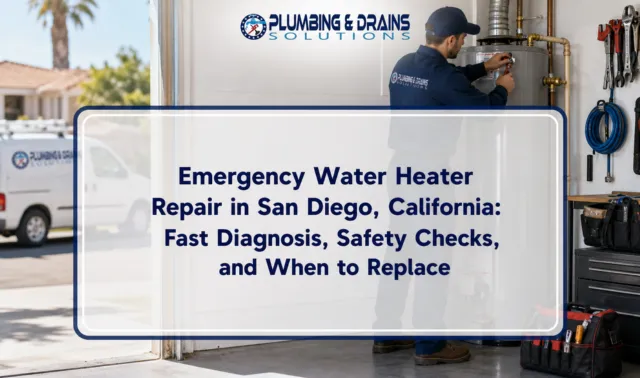
Emergency water heater repair San Diego homeowners call for is typically needed when there’s no hot water, a leaking tank, or signs of unsafe operation such as a gas odor, unusual noises, or tripped breakers. A fast, correct diagnosis helps determine whether the issue is a failed heating element or thermostat (electric), a pilot/ignition or gas control problem (gas), a blocked vent, or internal tank corrosion.
Because water heaters combine electricity, gas, water pressure, and high temperatures, basic safety checks matter before and during service. Shutting off power at the breaker (electric) or turning the gas control to “off” (gas), stopping the water supply, and watching for active leaks can reduce damage, while proper combustion venting and carbon monoxide risk awareness are critical for gas units.
This guide covers rapid troubleshooting steps, key safety considerations, and the warning signs that point to replacement—such as a ruptured tank, heavy rust in the water, recurring repairs, or persistent leaking around the unit.
First Response Checklist: What to Do in the First 10 Minutes
When you need emergency water heater repair San Diego homeowners can rely on, the first priority is to stop active damage and remove immediate hazards before troubleshooting.
Even if you plan to call a plumber right away, a few quick actions can limit flooding, reduce fire/CO risk, and preserve evidence of what failed.
- Shut off the energy source
- Electric: Turn off the dedicated breaker(s) for the water heater in the main panel.
- Gas: Turn the gas control valve on the heater to the “OFF” position.
- Stop the water
- Close the cold-water supply valve above the heater (usually on the inlet line).
- If the valve is stuck or leaking, stop water at the main home shutoff if needed.
- Limit flooding
- If there’s an active leak, place towels/pans and clear stored items away from the unit.
- If safe to do so, connect a garden hose to the drain valve and route it to a suitable drain area (avoid scalding).
- Check for gas odor or smoke
- If you smell gas or suspect combustion issues, avoid operating electrical switches and ventilate the area.
- Leave the building and contact the gas utility/emergency services as appropriate if odor is strong or persistent.
Common Emergency Symptoms and What They Usually Mean
Most urgent water heater calls boil down to “no hot water,” “leaking,” or “something seems unsafe,” and each symptom narrows the likely causes quickly.
Use the patterns below to decide whether you’re dealing with a simple component failure, a venting/combustion hazard, or a tank that’s reaching end-of-life.
No Hot Water (Or It Runs Out Too Fast)
A sudden loss of hot water often points to a power/gas interruption, a failed heating component, or a flame/ignition problem rather than a tank rupture.
- Electric heaters:
- Tripped breaker, blown fuse, loose wiring, or a failed upper/lower heating element.
- Faulty thermostat(s) or high-limit switch tripped due to overheating.
- Gas heaters:
- Pilot out (older units), igniter/flame-sensing problems, or gas control valve failure.
- Restricted air supply or venting issues that prevent proper combustion.
- Both types:
- Dip tube failure (hot water seems to “run out” quickly because cold water mixes at the top of the tank).
- Heavy sediment reduces usable hot water volume and heat transfer efficiency.
Water Around the Heater (Puddles, Drips, or Active Spraying)
Leaks can come from plumbing connections, temperature/pressure relief discharge, or the tank itself—each requires a different response and urgency.
- Leak from fittings/valves above the tank: Often repairable by tightening, re-sealing, or replacing a valve or flex connector.
- Dripping from the T&P relief valve outlet or discharge pipe: Could indicate excessive pressure/temperature, a failing relief valve, or a thermal expansion problem.
- Water seeping from the tank body or base: Frequently indicates internal corrosion; replacement is usually the safest path once a tank is leaking through steel.
Odd Noises: Popping, Rumbling, or Banging
Noises are commonly caused by mineral buildup, but they can also signal overheating and stress on the tank or components.
- Popping/rumbling: Sediment layer trapping steam bubbles at the bottom (common in hard-water conditions).
- Banging/water hammer: Pressure changes or loose piping; may be related to a failing pressure regulator or closed system expansion.
- High-pitched whine (some electric units): Sometimes tied to element issues or scale.
Tripped Breaker, Scorching Smells, or Burn Marks (Electric)
Electrical symptoms can indicate a shorted heating element, damaged wiring, or moisture intrusion and should be treated as a safety issue.
- Leave the breaker off if it immediately trips again.
- Do not remove covers unless you’re trained and using a meter to confirm power is off.
- Moisture + electrical components can create shock risk and component failure.
Gas Odor, Sooting, or Melted Plastic Near the Heater (Gas)
These warning signs can indicate incomplete combustion, venting failure, or a gas leak and should be treated as an urgent safety problem.
- Turn the gas control to “OFF” if it’s safe to approach.
- Ventilate and leave the area if odor is strong.
- Do not attempt repeated relighting if you suspect venting/backdrafting.
Rapid Troubleshooting: Electric vs. Gas Water Heaters
Basic troubleshooting can confirm whether the problem is upstream (power/gas supply) or inside the heater, but stop if you’re unsure—missteps can create shock, fire, or scald risks.
When the situation is urgent, the goal is not to “DIY a full repair,” but to gather clear symptoms that speed up a correct fix.
Electric Water Heater: Quick Checks That Don’t Require Disassembly
Without opening panels, you can still verify whether the issue is likely power-related, usage-related, or caused by sediment/age.
- Confirm the breaker status and whether it trips immediately after reset.
- Check for recent power outages or electrical work that may have affected the circuit.
- Observe recovery behavior: if water is lukewarm only after long waits, one element may be out.
- Look for visible leaking from the top fittings, which can drip into electrical compartments.
If the breaker continues to trip, the safest next step is professional diagnosis with proper electrical testing.
Gas Water Heater: Fast Visual and Operational Checks
Gas units often fail due to ignition, pilot, airflow, or control issues, and quick observation can narrow down the cause.
- Look at the status indicator on the gas control (many models flash a diagnostic code).
- Check the pilot/view window if present; if the pilot is out, avoid repeated relighting attempts if you smell gas.
- Inspect the area around the heater for blocked airflow (stored items, lint, dust buildup near the burner area).
- Check vent connection visually for obvious disconnection or damage (do not dismantle venting).
Because combustion and venting issues can raise carbon monoxide risk, an unstable flame, soot, or suspected backdrafting should be treated as an emergency.
Leak Triage: How to Tell a Minor Leak from a Tank Failure
Not every puddle means the tank is “done,” but a leaking tank itself is rarely a reliable candidate for repair.
Correctly identifying the leak source helps you avoid wasting time on patch attempts that won’t hold under pressure and heat.
- Top of heater wet, sides dry: Often a supply connection, shutoff valve, or expansion tank fitting leak.
- Relief valve discharge pipe dripping: May be a faulty T&P valve, excessive pressure, or thermal expansion; the underlying cause matters.
- Water at base with no obvious fitting leak: Can be tank corrosion or internal failure; sometimes condensation can mimic a leak, but persistent pooling is a red flag.
- Rust trails or staining: Suggest long-term seepage, often indicating deteriorating metal parts or tank corrosion.
If you’re already dealing with water damage, addressing the leak source quickly can prevent secondary issues in walls, cabinets, or flooring. In some cases, a water heater failure overlaps with broader water damage restoration service needs, especially when leakage is hidden or prolonged.
When Repair Makes Sense vs. When Replacement Is the Safer Call
Emergency decisions are easier when you focus on reliability and risk: some failures are contained and fixable, while others indicate the unit is near end-of-life or unsafe to keep running.
A qualified plumber can confirm with testing, but the signals below help set expectations before service arrives.
| Decision Factor | What It Often Indicates | Practical San Diego Considerations |
|---|---|---|
| Leak location | Fittings/valves may be repairable; tank-body leaks usually mean internal corrosion and replacement. | Garages and exterior closets are common locations; check whether water is reaching drywall, stored items, or adjacent living spaces. |
| Safety symptoms (gas odor, soot, backdraft signs) | Potential combustion/venting hazard that requires immediate professional evaluation. | Older homes and tight utility closets can have airflow/venting constraints; don’t keep operating the unit while symptoms persist. |
| Recurring breakdowns | Multiple component failures can indicate a unit nearing end-of-service life or compromised tank condition. | If you’ve already replaced major parts, consider whether another repair will restore reliable hot water during high-demand periods. |
| Rusty water or heavy sediment symptoms | Possible tank corrosion, deteriorated anode rod, or significant mineral accumulation. | Sediment can build over time; flushing may help in some cases, but rust discoloration can signal internal metal deterioration. |
| Capacity vs. household demand | Undersized heater can feel “broken” when it’s simply overwhelmed. | Consider changes like added bathrooms, frequent laundry, or guests; right-sizing can prevent repeated “no hot water” emergencies. |
Clear Signs Replacement Is Likely the Best Option
Some conditions strongly suggest replacement because repairs won’t reliably restore safety or prevent ongoing leakage.
- Tank is actively leaking from the body or base seam.
- Persistent leaking plus visible corrosion and repeated part failures.
- Burning/sooting signs that suggest chronic combustion or venting issues (until corrected and verified safe).
- Water damage around the unit from an extended, undetected leak.
What a Pro Will Typically Check During an Emergency Service Call
Professional diagnosis focuses on verifying safe operation first, then confirming the root cause efficiently to avoid repeat failures.
Exact steps vary by make/model and whether the unit is tank or tankless, but the workflow is often similar.
- Safety and shutdown verification
- Confirm power is off (electric) or gas is secured (gas).
- Evaluate whether the area is safe to work in (standing water, gas odor, venting concerns).
- Leak source isolation
- Check inlet/outlet connections, shutoff valves, unions, and relief valve discharge.
- Determine whether the tank itself is compromised.
- Component testing
- Electric: test thermostats, elements, wiring integrity, and high-limit behavior.
- Gas: inspect burner/ignition, flame signal, control operation, and venting basics.
- System conditions
- Look for excessive water pressure or expansion issues that can cause nuisance relief-valve discharge.
- Assess sediment/scale symptoms that can reduce performance and accelerate wear.
Related Plumbing Issues That Can Mimic a Water Heater Emergency
Sometimes the “water heater problem” is actually a plumbing distribution issue, a pressure problem, or a hidden leak impacting hot water delivery.
Ruling out these look-alikes can prevent unnecessary repairs and helps prioritize the right fix.
Crossovers, Failing Valves, or Fixture Problems
If hot water seems inconsistent only at certain fixtures, the heater may be fine and the issue may be local to a valve or faucet.
- Single fixture has no hot water: suspect that faucet cartridge, shutoff, or supply line.
- Temperature swings in showers: a worn mixing valve or shower valve can cause instability.
- Hot water is “lukewarm everywhere”: more likely heater output, thermostat, or capacity issue.
Drain or Sewer Conditions That Create Secondary Problems
Water heater failures can coincide with floor drain backups or poor drainage in garages and utility rooms, worsening the mess and slowing cleanup.
If flooding doesn’t clear or you suspect a blockage, reviewing practical drain steps like these tips to unclog your drain can help you recognize when a clog is part of the emergency and when it’s time for professional equipment.
Preparing for the Technician: Information That Speeds Up Emergency Repairs
Having a few details ready can reduce diagnosis time and help ensure the right parts and plan are identified sooner.
In emergency water heater repair San Diego situations, clear information often translates into a faster, more accurate repair decision.
- Fuel type: electric or gas (and whether the unit is tank or tankless).
- Symptoms timeline: when it started, whether it’s intermittent, and what changed recently (power outage, plumbing work, remodel).
- Visible leak location: top fittings, relief line, base, or unknown.
- Any safety indicators: gas odor, soot, breaker trips, scorch marks, or unusual flame behavior.
- Photos/video: of the control panel, any status lights, vent connection area (from a safe distance), and the leak source.
Why “Plumbing System” Context Matters in Water Heater Emergencies
A water heater isn’t isolated—it’s connected to the home’s water delivery, drainage, and safety controls, so the right fix often depends on the bigger plumbing picture.
Understanding the broader plumbing system helps explain why a symptom like relief-valve dripping can be caused by pressure/expansion issues elsewhere, not just a “bad heater.”
- Pressure and expansion: High incoming pressure or a closed system can trigger discharge at the relief valve if expansion isn’t managed properly.
- Piping condition: Corrosion, old shutoff valves, or failing connections can start leaking during normal temperature/pressure cycling.
- Drainage readiness: A slow floor drain can turn a small water heater leak into a larger water damage event.
Keeping Small Problems from Becoming the Next Emergency
Many emergency calls start as minor symptoms that were easy to dismiss—until the heater stops or a leak spreads.
Simple monitoring and periodic maintenance can’t prevent every failure, but it can reduce surprise breakdowns and help you plan replacement proactively.
- Watch for early warnings: intermittent hot water, small puddles, new noises, or rusty discoloration.
- Keep the area clear: avoid storing items that block combustion air or access to shutoffs.
- Know your shutoffs: identify the cold-water supply valve to the heater and the home’s main water shutoff.
- Address drainage issues early: if a utility-room or garage drain is slow, consider professional cleaning before the next leak event.
- Plan around age and reliability: if repairs are becoming frequent, replacement planning can be safer than waiting for a rupture.
Getting Back to Safe, Reliable Hot Water—Without Guesswork
Emergency water heater repair San Diego residents need is ultimately about two things: restoring hot water and making sure the unit is operating safely.
By shutting down hazards, identifying the most telling symptoms, and recognizing when replacement is smarter than repeated repairs, you can reduce damage and help the technician resolve the issue faster and more accurately.
Frequently Asked Questions
Need Help Troubleshooting a Water Heater Issue in San Diego?
When hot water stops, a tank starts leaking, or something feels unsafe, the right next step is getting a clear diagnosis so you can decide between a targeted repair and a safer replacement. A quick evaluation can also help reduce water damage and prevent repeat problems caused by pressure issues, failing valves, or sediment buildup.
If you’re unsure where the leak is coming from, your breaker keeps tripping, or you’re noticing gas odors, soot, or unusual noises, professional assistance can confirm shutdown steps, pinpoint the cause, and outline practical options based on your unit’s condition.